

/
/
Sustainable Sleep Habits: 8 Science-Backed Apps and Routines That Actually Work
A founder's honest guide to building sleep habits that last — combining behavior science, the right tools, and a refusal to join the 5 AM club.
Why most sleep advice fails (and what changed for me)
For years my sleep looked like this: fall asleep around 1 AM wired and vaguely anxious, wake up at 7 exhausted, survive the day with caffeine and willpower, repeat. I'd download a sleep app, use it for four nights, get bored, delete it, and feel slightly worse for having tried.
The internet's solution was always the same: become a 5 AM person, install eight new habits, drink lemon water, journal, meditate, cold shower, repeat for life. By Wednesday I'd given up. By Friday I was back to scrolling at midnight wondering what was wrong with me.
Eventually I realized the problem wasn't me, and it wasn't the apps. It was the framing.
Sustainable sleep isn't about heroic mornings. It's about removing the things that are quietly destroying your nights. Once I started thinking that way, everything changed — and the apps stopped being something I quit and started being something I actually used.
This guide is built around that shift. Six habits that genuinely work, eight apps that support them honestly, and zero advice that requires you to become someone you're not.
What "sustainable sleep" actually means
Most sleep articles treat sleep as a performance problem: how do you optimize it, hack it, get more of it. That framing is exhausting and rarely works.
A more useful definition: sustainable sleep is sleep you can keep getting, night after night, without it requiring willpower, perfect conditions, or a complete personality change.
That definition has three layers:
Personally sustainable — your sleep habits don't cost you more than they give back. No 4:30 AM alarms that ruin your weekends. No supplements you forget to take. No tracking obsession that wakes you up to check your score.
Environmentally sustainable — your bedroom and routine work with how you actually live, not against it. If you have kids, work nights, or share a bed with a snorer, the advice has to bend.
Socially sustainable — your sleep doesn't isolate you. The "perfect" sleep routine that means you can never go to dinner with friends past 9 PM is not a routine, it's a prison.
The six habits and eight apps below are chosen because they win on all three layers. They're boring. They work.
Why the "5 AM club" is the wrong goal
Quick myth-busting: there's no science behind 5 AM specifically. There's plenty of science about sleep consistency (going to bed and waking up at similar times). Whether that consistent time is 5 AM or 7 AM or midnight to 8 AM matters far less than the consistency itself.
If 5 AM works for you because you're a natural early bird with no children and an empty calendar at 9 PM, great. For most people it's a recipe for chronic sleep debt and quiet resentment.
A user on r/getdisciplined put it perfectly when describing their old pattern: "I felt I had to wake at 5 to be a serious person, and I just spent every day exhausted and pretending." That's the trap. Don't fall into it.
The 6 sustainable sleep habits that work
These are ordered roughly from easiest to hardest. Pick one. Do it for two weeks. Then add another only if the first one feels automatic.
1. Phone outside the bedroom (the foundational one)
This is the single highest-leverage habit on this list, and the one most people refuse to do.
The science: screen exposure in the 60 minutes before sleep suppresses melatonin production by 23-50%, depending on the study. But the bigger problem isn't the blue light — it's the cognitive activation. Your brain can't transition into sleep mode while you're processing 47 unrelated stimuli per minute.
The honest reason it's hard: for most of us the phone in bed isn't really about reading or messaging. It's a coping mechanism for the anxiety that surfaces the moment our environment goes quiet.
How to start: charge your phone in the kitchen. Buy a $15 alarm clock. The first three nights are uncomfortable. The fourth feels like a small relief. By night ten you wonder why you spent years not doing this.
2. Consistent sleep window (not perfect timing)
Forget the exact bedtime. Pick a 90-minute window instead. For example: "in bed between 10:30 PM and midnight." That's your sustainable target.
Why this works: rigid bedtimes break the moment life gets complicated. A window adapts to weeknights, weekends, dinners, dates, travel. The goal is consistency on average, not perfection on Tuesday.
The deeper insight: wake-up time matters more than bedtime for circadian rhythm. If you can wake up within a 60-minute window every day (including weekends), your sleep system stabilizes even when bedtimes vary.
3. Caffeine cutoff at 2 PM
Caffeine has a half-life of 5-7 hours. The espresso at 4 PM still has half its strength in your bloodstream at 9-11 PM. Even if you "don't feel it," it's measurably degrading your deep sleep.
The honest reason most people skip this: afternoon caffeine isn't really about energy. It's about pleasure, social ritual, the feeling of taking a break. Removing it without replacing it fails.
How to start: find a 2-3 PM ritual that isn't caffeine. Decaf espresso (yes, it's a thing). Sparkling water with lemon. A 10-minute walk. The point isn't deprivation, it's substitution.
4. 5-minute wind-down ritual
Not 30 minutes. Not an hour. Five minutes, every night, doing the same boring thing.
The science: repetition creates a Pavlovian sleep cue. The same boring sequence — every single night — eventually triggers sleep onset automatically.
Sustainable wind-down examples:
Make tea, drink it slowly, brush your teeth
Read a paper book for five minutes
Stretch your shoulders and neck while standing in the kitchen
Write three lines about your day in a notebook (no app, no phone)
Anti-examples (sustainable for nobody):
30-minute skincare routine
Yoga nidra session that requires headphones
Journaling prompts that take effort
The whole point of "5 minutes boring" is that it works on the worst nights, not just the good ones.
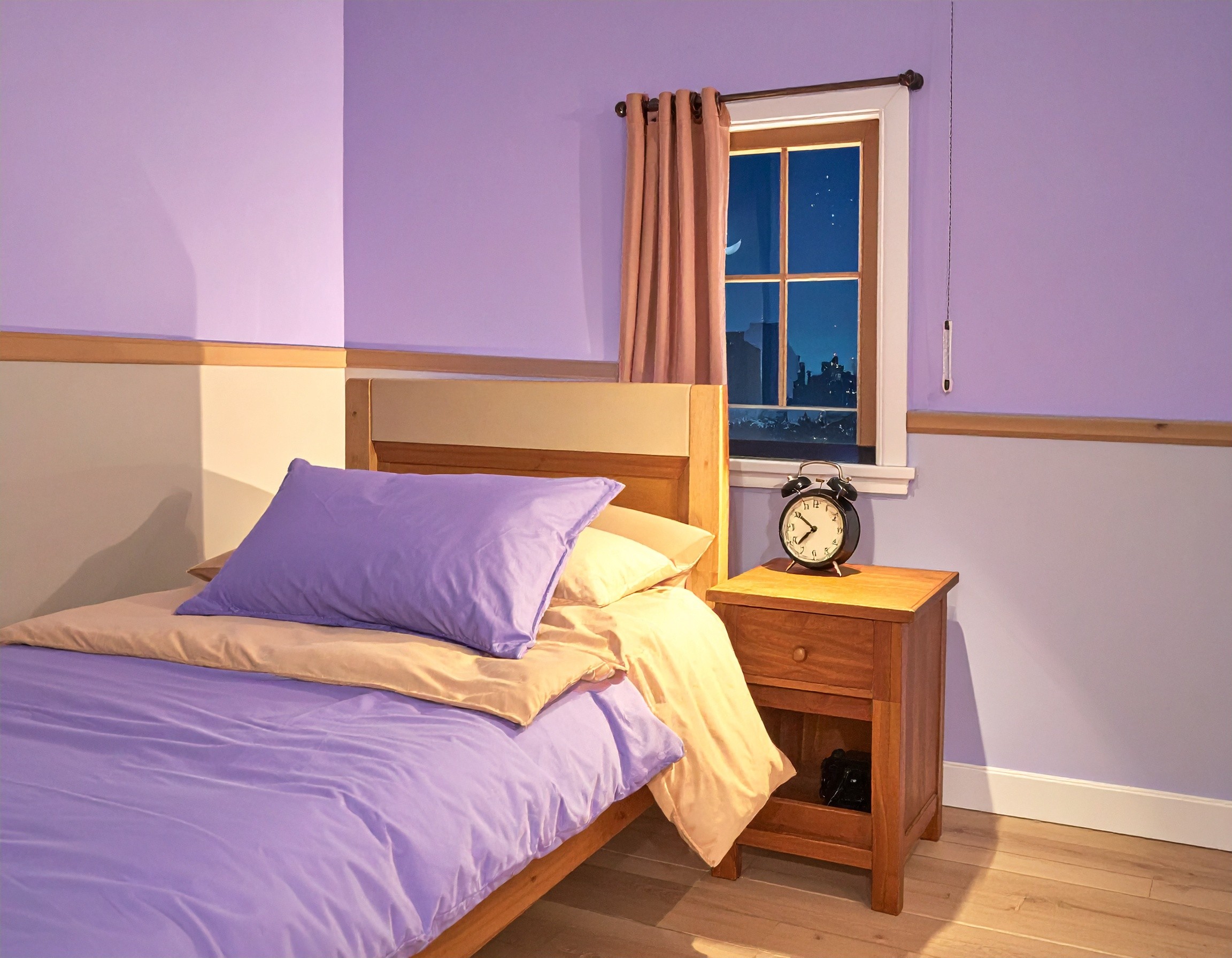
5. Cool, dark, boring bedroom
Your bedroom should be the most boring room in your house. Most aren't.
The science: core body temperature needs to drop ~1°C for sleep onset. Bedrooms above 20°C / 68°F directly impair sleep architecture. Light pollution — even small amounts — measurably reduces deep sleep duration.
Quick wins:
Bedroom thermostat at 17-19°C / 63-67°F
Blackout curtains or a sleep mask
Remove the TV (yes, really)
Charge electronics outside the room (the small LEDs matter)
Make the bed a sleep-only zone — no working, no scrolling, no eating
The honest part: doing all of this requires zero willpower once it's set up. It's a one-weekend project that pays back every night for years.
6. Forgiving the bad nights
This is the habit nobody talks about and the one that determines whether the other five stick.
You will have bad nights. Travel, anxiety, a sick kid, a noisy neighbor, hormones, a stressful Sunday before a Monday deadline. Bad nights are not failures. They become failures only when they cascade into bad weeks.
The rule that works: never compensate. Don't try to "catch up" on Saturday by sleeping until 11. Don't take a 2-hour afternoon nap to "make up for it." Don't double up on caffeine. Just go to bed at your normal window and let your body recover at its own pace.
A Reddit user on r/sleep wrote something I keep coming back to: "I stopped tracking my sleep and started just trusting it. The score I was getting was making me anxious about being anxious about sleep." That's the meta-trap with sleep tracking. We'll get to it in the apps section.
8 sleep apps that actually support these habits (not replace them)
The right sleep app supports a habit. The wrong one becomes the habit, which is exactly the trap we're trying to escape.
These eight are chosen because they help with at least one of the six habits above, without becoming a new chore.
1. Calm — Best for the wind-down ritual
What it does: guided meditations, sleep stories narrated by Matthew McConaughey and other improbably soothing voices, ambient soundscapes.
Why it stands out: the sleep stories are unironically excellent. They're written and paced specifically for sleep onset, not entertainment. Twenty minutes in and you're out.
Honest take: Calm is best as a transition tool, not a forever tool. Use it nightly for 2-3 weeks to establish your wind-down ritual, then either continue or replace with silence — whichever is more sustainable for you.
For a deeper look at Calm's mindfulness features, see our 10 Best Apps for Mindfulness & Mental Training guide.
2. Headspace Sleep — Best for structured sleep coaching
What it does: Sleepcasts (audio designed for falling asleep), sleep meditations, wind-down sessions, sleep music.
Why it stands out: Headspace's clinical approach has actually been studied. A 2018 randomized trial in PLOS ONE showed measurable improvements in sleep quality after 4 weeks of use. That's rare in the wellness app space.
Honest take: the subscription is pricey for what it is. If you're paying $70/year just for sleep features, look at Insight Timer (#6) which has comparable content for free.
3. Sleep Cycle — Best for sleep tracking without obsession
What it does: uses your phone's microphone to track sleep stages, snoring, and movement. Wakes you during light sleep within a window you set.
Why it stands out: the smart alarm is the genuine breakthrough. Waking during light sleep (rather than in deep sleep at a fixed time) makes a real difference in morning grogginess.
Honest take: don't track every night. Use it for 1-2 weeks to understand your patterns, then stop. Continuous tracking creates orthosomnia — the anxiety condition where worry about sleep starts causing the bad sleep you're worried about. Real condition, real risk.
4. Pillow — Best for Apple Watch users
What it does: sleep tracking via Apple Watch, sleep aid sounds, sleep coaching insights.
Why it stands out: if you already wear an Apple Watch to bed, Pillow's integration is dramatically smoother than Sleep Cycle's microphone-based tracking. The data is also more accurate.
Honest take: wearing a watch to bed is itself a sleep stressor for some people. If you sleep worse with the watch on, the data isn't worth it. Test for one week, judge honestly.
5. Loóna — Best for racing-mind nights
What it does: combines guided breathing exercises with interactive scene-painting (yes, really) and bedtime stories.
Why it stands out: Loóna is designed specifically for the night where your mind won't shut up. The interactive element gives your conscious mind something gentle to do while your nervous system winds down. Sounds gimmicky, works surprisingly well.
Honest take: not for daily use. It's a "tool in the toolbox" for the 2-3 nights a month when your brain is sprinting at midnight.
6. Insight Timer — Best free option
What it does: the largest free library of meditations, sleep music, yoga nidra, and bedtime stories on the internet. Most content is genuinely free, no subscription required.
Why it stands out: if you're skeptical that sleep apps are worth paying for, start here. Yoga nidra recordings on Insight Timer are particularly effective — search for "yoga nidra for sleep" and pick one of the 30+ free options.
Honest take: the UX is clunky and the algorithm pushes paid content. Both worth tolerating for the free library.
7. Endel — Best for ambient soundscapes
What it does: generates personalized soundscapes that adapt to your circadian rhythm, weather, and even heart rate (with Apple Watch).
Why it stands out: Endel's "Sleep" mode uses scientifically researched sound frequencies to support transitions into deep sleep. The sound design is genuinely beautiful — closer to ambient art than wellness app cliché.
Honest take: more useful for falling asleep than for tracking. Pair with one of the trackers above if you want both.
8. Yoga Nidra (free practices on Insight Timer or YouTube)
What it does: yoga nidra is a guided meditation specifically designed to bring the body into a state biologically similar to sleep, while the mind remains lightly aware.
Why it stands out: 20 minutes of yoga nidra has been shown to provide restorative benefits comparable to 1-2 hours of sleep, in research from the All India Institute of Medical Sciences.
Honest take: this isn't an app, it's a practice. Use the free recordings on Insight Timer. The effect is real and almost immediate — it's the closest thing to a sleep "cheat code" I've found.
How to know if your sleep is actually improving
Most people obsess over the wrong metrics. Here's the honest version of how to measure progress:
Stop tracking:
Sleep score (varies 20% night-to-night for no real reason)
Exact REM/deep sleep percentages (consumer wearables have ±30% error)
Total time in bed (irrelevant if you're not actually sleeping)
Start noticing:
Do you wake up before your alarm 1-2 days a week? (This is the gold standard of recovered sleep.)
Do you make it through 3 PM without feeling drained?
Is your mood more stable across the week?
Do you remember dreams occasionally? (Suggests you're hitting REM sleep.)
These four signals, observed over 2-3 weeks, tell you more than 90 days of app data.
Where Lisia fits in
If you want a structured way to do this — small, science-backed sleep habits across one of Lisia's 8 wellbeing dimensions, without the overwhelm of installing yet another tracker — that's part of what we're building.
Lisia treats sleep as one of eight interconnected sustainable habits, not an isolated optimization problem. Movement during the day affects sleep. Caffeine timing affects sleep. Mindfulness affects sleep. Each habit reinforces the others, and the system is designed to be sustainable, not heroic.
We're letting in a small group of early users right now. No pressure if it's not for you — but if you've ever tried a sleep app and quit, we built this specifically for that feeling.
Frequently asked questions
What is the most important sleep habit?
Phone outside the bedroom. Not because of blue light specifically, but because of cognitive activation. The single change that makes the biggest measurable difference for most people, and the one most refuse to do. Try it for ten nights and judge honestly.
How long does it take to fix bad sleep habits?
Sustainable improvement takes 3-6 weeks for most people, not three days. The first week feels harder before it feels easier. The third week is when it starts feeling automatic. The "30 day sleep transformation" framing is mostly marketing — real change is slower and stickier.
Are sleep tracking apps actually accurate?
Consumer wearables (Apple Watch, Fitbit, Oura) have ±20-30% error rates compared to clinical sleep studies. They're useful for trends, not absolute numbers. The biggest risk is orthosomnia — the anxiety created by obsessing over imperfect data. Use sleep tracking for 1-2 weeks to learn your patterns, then stop daily tracking.
What's the best sleep app for free?
Insight Timer has the largest genuinely free library of sleep content (meditations, yoga nidra, sleep music, bedtime stories). If you want to test whether sleep apps work for you before paying, start there.
Is the 5 AM club actually good for sleep?
There's no science specifically supporting 5 AM. The actual research supports sleep consistency — going to bed and waking up at similar times every day, including weekends. Whether that consistent time is 5 AM, 7 AM, or 11 PM to 7 AM matters far less than the regularity itself. Pick a window that works with your real life.
Can I really not use my phone as an alarm clock?
You can, but you almost certainly shouldn't. The phone-as-alarm is the trojan horse for phone-in-bed scrolling. A $15 alarm clock pays for itself in better sleep within the first week. It's the cheapest health investment you can make.
Lisia is an AI-powered wellness app helping people build sustainable habits across 8 dimensions: movement, nutrition, mindfulness, sleep, learning, communities, body care, and sustainable actions. Featured in the VML Future 100 (2026) report and named a semifinalist in the 2026 Harvard President's Innovation Challenge. Join the beta at lisia.io.